BIM Upskilling

Skip to main content
BIM Upskilling home. BIM
  • Home
    • About Us
      • Platform Introduction
      • BIM Introduction
    • Public Learning Content
    • HS2 Learning Area
      • HS2 Staff Learning
      • HS2 Engineer Learning Area
    • Digital Systems Guides
      • GIS Tools
      • VisHub2.0
      • CollabHub
      • Contractor Area
    • My Learning Records
  • Log In
BIM Upskilling home. BIM
  • About Us
    • Platform Introduction
    • BIM Introduction
  • Public Learning Content
  • HS2 Learning Area
    • HS2 Staff Learning
    • HS2 Engineer Learning Area
  • Digital Systems Guides
    • GIS Tools
    • VisHub2.0
    • CollabHub
    • Contractor Area
  • My Learning Records

    HS2 Logo

    1. Home
    2. About BIM


    Building Information Modelling (BIM) is a collaborative way of working, underpinned by the digital technologies which unlock more efficient methods of designing, creating and maintaining our assets. BIM embeds key product and asset data and a 3 dimensional computer model that can be used for effective management of information throughout a project lifecycle – from earliest concept through to operation.


    BIM Stages


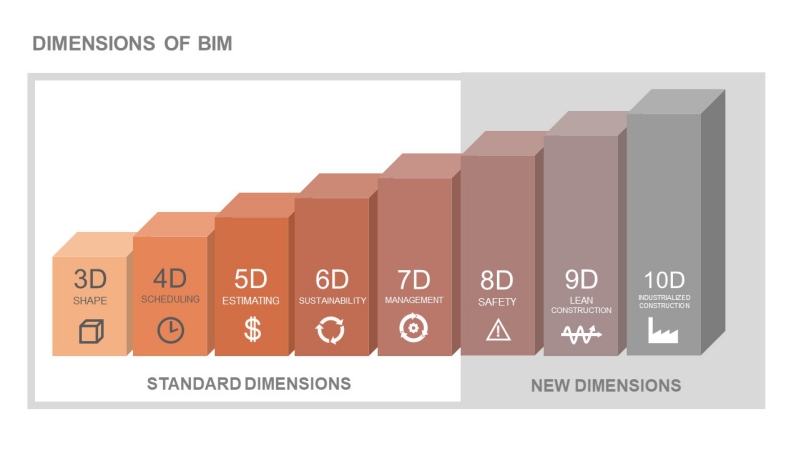
    BIM is comprised of ascending 'maturity levels', with each level harnessing BIM's potential for a greater impact on the construction project.


    3D BIM: Represents the spatial representation of the physical elements of a building or infrastructure project.

    4D BIM: Adds the dimension of time to the 3D model, incorporating scheduling and sequencing information.

    5D BIM: Combines the 3D model with cost data, allowing for accurate cost estimation and budgeting.

    6D BIM: Includes sustainability and energy analysis, enabling the evaluation of environmental performance.

    7D BIM: Integrates facility management information, such as O&M manuals and asset management data.

    8D BIM: Enhances safety management by integrating risk assessments and hazard mitigation into the model.

    9D BIM: Optimise construction processes and reduce waste through the use of BIM

    10D BIM: Increase efficiency and productivity by using off-site construction methods and prefabrication

    Transforming Infrastructure Performance (TIP) Roadmap to 2030 [Link]
    UK BIM Framework: approach to implementing BIM in the UK [Link]
    HM Government: Building Information Management [Link]


    BIM Use Case - HS2/Align


    Back to top
    T&Cs
    UK GDPR & Privacy Policy
    Help
    Accessibility Statement

    T&Cs    GDPR & Privacy Policy    Help    Platform Feedback    Accessibility Statement

    Facebook
    Twitter
    Linkedin
    Instagram
    Youtube

    Facebook  Twitter  Instagram  Linkedin  Youtube

    © High Speed Two Ltd 2023